
Marketing is not a specific job; it is a process, a series of different jobs that are closely linked to each other and to other jobs besides marketing. Marketing is one of the most important parts in the business field. It can be said that marketing is the decisive factor for the survival of an entire business.
To best understand marketing, I will summarize all of it, from the beginning when people started doing business to the current era of business with powerful digital technology. Let’s find out with me.
1. Overview of the formation of economies
Since the beginning of time, when people began to enter the agricultural revolution, it led to the emergence of economies. From producing food to creating a self-sufficient economy (people produce their own products and consume themselves). People have gradually advanced to a commodity economy (with division of work, exchange of goods and services between individuals) to satisfy their own needs.
In the early stages, commodity exchange only took a direct form (goods for goods). At this stage, problems form when people cannot meet others who have what they need or/and need what they have (for example, Mr. A has vegetables and wants to use the vegetables in exchange for Mr. B’s pork, but Mr. B doesn’t want to eat Mr. A’s vegetables). When this problem occurs, the exchange cannot be performed.
To solve this problem, people need an intermediary to represent the value of the product they want to exchange. And an extremely great invention was born, something that has changed the entire human world until now, which is money.
When money was born, people viewed money as a measure of product value and used money as a means of exchange. Exchange takes place when there are more than two individuals and all individuals desire and agree with the value that the other party exchanges. That is the basis for forming a monetary economy.
“With the same land area, farmers can grow a large number of edible plants. This increased food supplies and human societies were able to feed more people, which in turn led to population explosions, food hoarding, and the creation of something to exchange it for: Money.” – Sapiens: A Brief History of Humankind (Author: Yuval Noah Harari)
The commodity economy has many exchange mechanisms, specifically:
- Exchange based on market prices creates a market economy.
- Exchange based on planning arrangements creates a planned economy.
In a commodity economy, the dominant form of economic relations is commodity-currency relations. It contrasts with natural economics, in which the dominant form is physical relations.
2. The formation and development process of marketing
In a commodity economy, sales are one of the final stages of the production and business process. During this period, inherent contradictions appear in business activities:
- Conflicts about supply and demand relationships.
- Conflict about price-value relationship.
- Conflicts about competitive relations.
These conflicts are increasingly evident and difficult to resolve. The congestion in resolving the above conflicts will cause the process of remanufacturing products to stagnate.
Therefore, businesses try to resolve these conflicts by finding the most reasonable and optimal solutions to ensure the goods can be sold and make the product remanufacturing process run smoothly.
Resolving the inherent conflicts of production and business activities is the scientific basis and the starting point for the formation of marketing activities.

Figure 1: diagram depicting marketing intervention in the sales process
Marketing activities have actually existed since the 17th century. By the 19th century, there were research works on marketing, but the term “marketing” first appeared in the United States in the early years of the 20th century.
After the world economic crisis (1929-1932), marketing and its issues appeared quite widely and were commonly applied in the capitalist world.
In the 50s and 60s of the 20th century, marketing was strongly spread to third-world countries, and business people have been interested in researching and applying it to business practices until today.
Since its inception, marketing has gone through a process of development and improvement, which can be divided into two main stages:
- Traditional marketing period (from its appearance until before World War II).
- Modern marketing period (from after World War II to present).
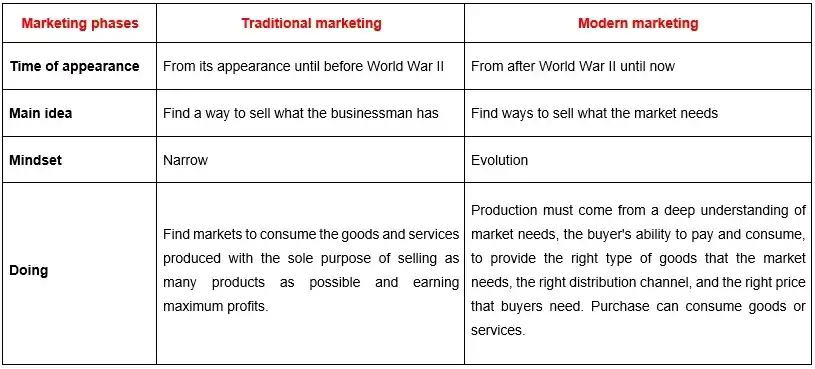
Figure 2: comparison of two marketing stages
The economic conditions after World War II were the objective cause for the birth of modern marketing. After World War II, the economic situation gradually changed many things, including:
- Strong economic development.
- Science and technology develop relatively quickly.
- Market competition is fierce.
- Prices of raw materials and goods fluctuate strongly.
- There are many risks in business.
- Redundancy crises occur continuously.
In that context, the traditional marketing perspective cannot resolve the contradictions of business activities; the birth of modern marketing has greatly contributed to overcoming excess crises and promoting production, science and technology continue to develop.
Excess crisis is a crisis in which the quantity of goods produced is large while consumer demand is limited, meaning supply is greater than demand. The overcapacity crisis occurred after the British industrial revolution, when machines gradually replaced labor, causing mass unemployment and no income for workers. Meanwhile, more and more goods are produced, and they do not have money to buy those consumer products.
3. Another approach to the stages of marketing development (reference)
From this perspective, people propose the formation and development of marketing through two periods:
- From 1900 to 1960: marketing was considered an applied branch of economic science.
- From 1960 to present: marketing has been considered an applied field of behavioral science.
During the period from 1900 to 1960, the first schools of marketing gradually appeared, first three schools: the organizational school, the functional school, and the commodity school, and then two schools: the school of management and the school of society.
Marketing at this stage is based on two main premises:
- Firstly, marketing is essentially an economic activity, and it is a subfield of economic science. Therefore, marketing perspectives are limited to the economic behavior of participating members (people, organizations).
- Second, the subjects of marketing activities in the market are marketers, not consumers. Although marketing during this period recognized the need to understand consumer behavior through market research, it was only seen as an input factor for the design of marketing programs.
Starting from 1960 onwards, the two marketing premises mentioned above were replaced by other, more suitable premises:
- First, is the replacement of the premise of economic exchange with the premise of value exchange. This is the stage where marketing moves from applied economic science to applied behavioral science. This change created three new schools, which are the macromarketing school, the consumer protection school, and the system school.
- Second, the replacement of the premise that the subject of marketing is the marketer with the premise of balance of power, or that the subject of marketing is the consumer,. This replacement led to the emergence of three more schools of marketing, which are the consumer behavior school, the organizational behavior school, and the strategic planning school.
The above six schools of thought have contributed greatly to the development of marketing and created the basis for turning marketing into an independent science.
One of the new directions that many marketing researchers are most interested in is probably the ability to replace the mixed marketing model with the relationship marketing model.
One of the important contributions of relationship marketing is the introduction of the concept of marketing network, which includes the company and its staff, customers, suppliers, wholesalers, retailers, dealers, scientists in universities, research institutes, etc.
On this basis, the concept of competition also shifts from competition between companies to competition between network operators.
The second direction that also stimulates many marketing researchers and is very popular today is research on the role of the internet in marketing.
The transition from the physical marketplace to the market space, also known as the virtual marketplace, creates new research directions for marketing.
– To be continued –
Thank you for reading my sharing, hopefully it has brought more or less useful value to you.
- Sky -